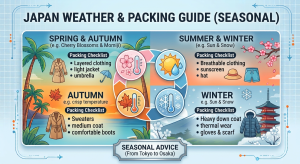
Japan stretches across a long island chain, creating dramatic differences in weather between regions and seasons. The country experiences four distinct seasons, each requiring different clothing choices and travel considerations.
🌸 Spring (March to May)
Spring is one of the most popular times to visit as the iconic cherry blossoms (sakura) sweep across the nation.
-
The Climate: Mild, crisp, and highly pleasant. Temperatures generally range from 10°C to 20°C (50°F to 68°F).
-
Packing Strategy: The key to spring travel is light layers. Mornings and evenings can remain quite brisk, while afternoons warm up comfortably under the sun. Pack sweaters, a light windbreaker or denim jacket, scarves that can be easily removed as the temperature changes, and comfortable walking shoes.
☀️ Summer (June to August)
Summer is vibrant with local festivals and fireworks, but it demands serious physical preparation for the elements.
-
The Climate: Intense heat and extreme humidity, peaking in July and August with temperatures often reaching above 30°C (86°F). June to mid-July also brings the rainy season, known as Tsuyu, featuring heavy downpours and high humidity, followed by the start of the autumn typhoon season.
-
Packing Strategy: Pack ultra-breathable, quick-dry clothing (such as linen or athletic moisture-wicking fabrics) to manage the intense humidity in urban concrete centers. A compact, sturdy travel umbrella is essential for sudden cloudbursts, along with a small hand towel and a portable fan to help stay cool while walking.
🍁 Autumn (September to November)
Autumn rivals spring as a premier travel window, famed for its breathtaking, fiery fall foliage (koyo).
-
The Climate: Mild, stable, and highly comfortable. Temperatures mirror spring, generally ranging between 10°C to 20°C (50°F to 68°F), but the air is generally much drier and crisper.
-
Packing Strategy: While September can still hold onto lingering summer heat and typhoon rains, October and November cool down beautifully. Travelers will need warmer layers for the evenings, including a medium-weight jacket or a light coat, especially if spending extended hours outdoors for evening illuminations.
❄️ Winter (December to February)
Winter transforms the country, offering stunning snow-covered shrines, winter illuminations, and world-class skiing destinations.
-
The Climate: Sharp and cold. While northern regions like Hokkaido and the Japan Alps experience massive blizzards and heavy snowfall, major coastal cities like Tokyo, Kyoto, and Osaka stay mostly dry and clear but cold, with temperatures averaging 0°C to 10°C (32°F to 50°F).
-
Packing Strategy: A proper heavy winter coat or puffer jacket, thermal base layers, a beanie, gloves, and thick socks are necessary. Keep in mind that while it is freezing outside, Japanese trains, department stores, and hotels crank up their indoor heating significantly—wearing layers that are easy to unzip or remove prevents overheating indoors.
Year-Round Packing Essentials
👟 Comfortable Walking Shoes
Japan is a walking destination. Even travelers who use trains extensively can easily walk several miles a day between stations, neighborhoods, temples, shopping areas, and attractions.
Choose shoes that are:
- comfortable for long distances
- easy to remove (you will occasionally take shoes off at temples, ryokans, and some restaurants)
- suitable for the season and weather conditions
- breaking in a new pair of shoes during your Japan trip is not recommended
🧥 Layers
Japan’s temperatures can change throughout the day, and indoor heating or air conditioning can be very different from outdoor conditions.
☔ Compact Umbrella
Rain can appear unexpectedly, and convenience stores make it easy to replace one if needed.
🎒 Comfortable Day Bag
A small backpack or crossbody bag is useful for carrying:
- water
- purchases
- portable battery
- umbrella
- extra layer
💡 The Golden Rule: Japan Has Multiple Climates
Japan’s mountainous terrain creates significant regional differences in climate. Before packing, check the forecast for your specific destinations. Japan’s regions can experience very different conditions during the same season. A single train ride from a major coastal city up into the mountain regions or the northern prefectures can drop the temperature by a massive margin in less than two hours.
Understanding Japan’s weather is an important part of planning a successful trip. Now it’s time to decide where you want to go and begin building an itinerary that matches your interests, schedule, and the season you’ve chosen to visit. Remember, there is no “perfect” itinerary—only the one that’s right for you. Continue to Planning Your Japan Itinerary