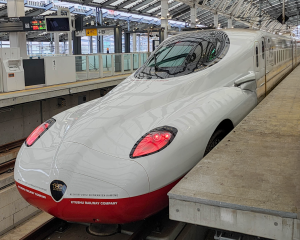
Japan’s Shinkansen (bullet train) network is legendary for its speed, punctuality, and comfort. For most first-time travelers, riding the bullet train is a highlight of the trip. However, navigating the booking systems and stations can feel intimidating. This guide breaks down everything you need to know to ride like a local.
⚠️ Important: The JR Pass Warning
If you have read older travel advice recommending the national Japan Rail (JR) Pass for bullet train travel, please note that this advice is outdated. Due to recent 65% price hikes, the national pass is a financial trap for standard itineraries (like the classic Tokyo-Kyoto-Osaka route). Buying individual point-to-point tickets is significantly cheaper, easier, and lets you ride the fastest trains. Click here to read more.
📱 How to Book Your Tickets Natively
The absolute easiest way to book individual bullet train tickets for the popular golden route (Tokyo – Nagoya – Kyoto – Osaka) is through the official SmartEX app or website.
-
Book in Advance: You can book your seats up to 30 days in advance. This is highly recommended if you are traveling during peak seasons or holidays.
-
Link to Your Digital Transit Card: The SmartEX app allows you to link your purchased tickets directly to your digital IC transit card (like Suica or Pasmo) on your phone. When you arrive at the station, you simply tap your phone at the Shinkansen turnstile, and it will print out a small seat assignment slip automatically.
-
The “Fast” Trains (Nozomi & Mizuho): When booking individual tickets, always aim for the Nozomi or Mizuho trains. These are the fastest models with the fewest stops, completing the trek between Tokyo and Kyoto in just about 2 hours and 15 minutes.
🧳 The Oversized Baggage Rule
If you are traveling with large luggage, Japan Rail has specific rules you must follow to avoid a fine on the train.
-
What Counts as “Oversized”? If the total dimensions of your suitcase (length + width + height) add up to between 160 cm and 250 cm, it is legally classified as oversized.
-
Reserve a Dedicated Seat: When booking your ticket on the SmartEX app, you must specifically select a “Seat with an Oversized Baggage Area” or “Seat with an Oversized Baggage Compartment.” These are typically the very last rows of the car. There is no extra fee for this, but spaces are limited!
-
Standard Carry-ons: If your luggage is standard carry-on size or a medium suitcase (under 160 cm total), you do not need a reservation. It will easily fit on the overhead racks above your seat.
🚉 Navigating the Station & Boarding
-
Look for the Shinkansen Gates: Shinkansen tracks are completely separate from local commuter train tracks. Follow the bright blue signs in major hubs like Tokyo Station that say “Shinkansen.”
-
The Ticket Gate Double-Tap: If you are transferring from a local subway line to the Shinkansen, you will pass through a transfer gate. You will need to tap your local transit card and scan your Shinkansen QR code (or paper ticket) at the exact same gate to transition through.
-
Line Up by Car Number: Look at your seat assignment for your Car Number (e.g., Car 5). On the station platform, look at the floor or overhead displays—there are exact markings showing you exactly where Car 5 will stop. Wait patiently in queue behind the lines.
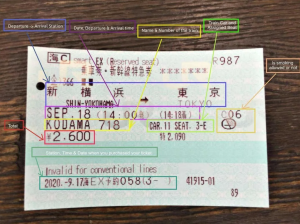
🎫Your Shinkansen Ticket and How to Read It
🍱 Shinkansen Etiquette & The Ekiben
-
The Train Bento (Ekiben): Unlike local commuter trains where eating is strictly forbidden, eating and drinking on the Shinkansen is a massive part of the travel culture! Before boarding, stop by a platform kiosk to pick up an Ekiben (a beautifully arranged station lunchbox) and a drink to enjoy at your seat.
-
Keep it Quiet: The bullet train is incredibly quiet. Keep your voice at a low murmur, switch your smartphone to silent (“Manner Mode”), and use headphones for audio. If you must take a phone call, step into the corridor area between the train cars.
-
Reclining Your Seat: It is a polite custom to quickly bow and ask the person behind you (“Sumimasen”) before reclining your seat back.